

Halloween is coming up, and I will be doing trick-or-treating with my kids. Over the years, I have noticed more and more doorbell cameras popping up. These cameras create a constant feeling of being watched as you walk door to door. With that feeling and the recent cybersecurity events, I have been thinking about the security and privacy of our children.
As we venture out to trick-or-treat this year, I expect every single doorbell in my neighborhood will have a camera, recording the footage of my children dressed in their Halloween costumes getting candy. So I looked into the products and the decisions the product teams behind these cameras are making, like, what is an easy setting to toggle on/off, what’s a default buried deep six steps in, who decides consent, what gets shared with the local authorities, and which feature gets an AI upgrade. These settings say a lot about the incentives that drive those decisions.
In 2023, the FTC reported charges against Ring. Most of it is about people watching the videos. Before 2017, every Ring employee, and hundreds of contractors, had full access to every customer video, including cameras inside people’s bedrooms. One employee spent months watching videos of female customers from cameras named “Master Bedroom” and “Master Bathroom.” One of the stated reasons why employees were looking at the footage was to “train algorithms”, labeling people and objects, among other things. But Ring didn’t properly tell customers or get their consent. Ring neither admitted nor denied the allegations and settled for $5.8M, and the order required Ring to delete the data, models, and algorithms it built from videos it reviewed unlawfully.
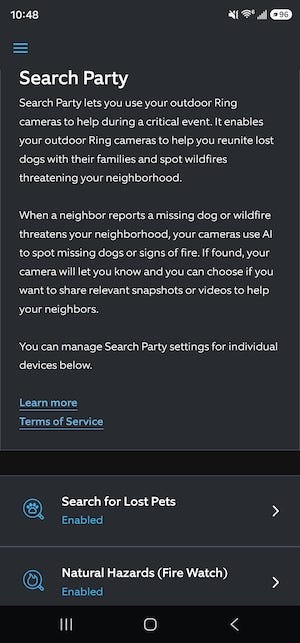
That conduct was before 2023. There are lots more AI features now available, from finding a lost pet to searching for similar moments. The cameras are not just recording; the AI is also ‘watching’. It’s like a network of devices tracking every move. For its part, Ring states that the facial recognition of familiar, frequent faces is off by default, leaving the homeowners to follow consent laws. Really? Do we all know what those are in our states? Like, ‘Familiar Faces’ isn’t offered at all in Illinois, Texas, or Portland (OR) because of their biometric laws.
While I appreciate the feature to help search for a lost dog, or a neighborhood watch to keep homes and families safe, I worry about the privacy of the children and their parents who have not opted in to be recorded.
As I write this, I have a Ring camera on my front door, and I am in the same predicament as other parents who do, who come to my door for trick-or-treating, and I looked into the app, and all the settings are defaults. I could not find any setting that lets me opt out of using my video footage to train AI models. Ring’s disclosures are thin about AI training of models. I haven’t changed any settings yet, but I am thinking about how we manage the privacy of our children and that of our neighbors.
Even worse, there is a growing trend of homeowners uploading footage of kids’ mistakes, like taking too much candy, to social media or neighborhood apps, which can reveal a kid’s identity and location. And as parents, we have no control over the behaviors of those adults.
Two things are true: I would be relieved to have the footage if something happened on my street, and still hate the feeling of my kids being recorded when they are out. So here’s what I am telling my kids this Halloween:
Assume every porch has a camera and act as if the homeowner is standing in front of you. Be polite and respectful.
If an unattended bowl says “Take one”, only take one. More candy is not worth ‘viral shaming’ if the video ends up online.
Microphones work both ways. Don’t complain about the candy, the decorations, or share anything private.
My kids are little and don’t have their own phones. But I’d tell the teenagers not to post videos or photos of their friends in their costumes online without consent.
What are you telling your kids this Halloween?